If you’ve ever sat at a red light at 2 a.m., staring at an empty road while your patience slowly evaporates, you’ve already felt one of the biggest flaws of traffic lights. They force traffic to stop—even when stopping makes no sense.
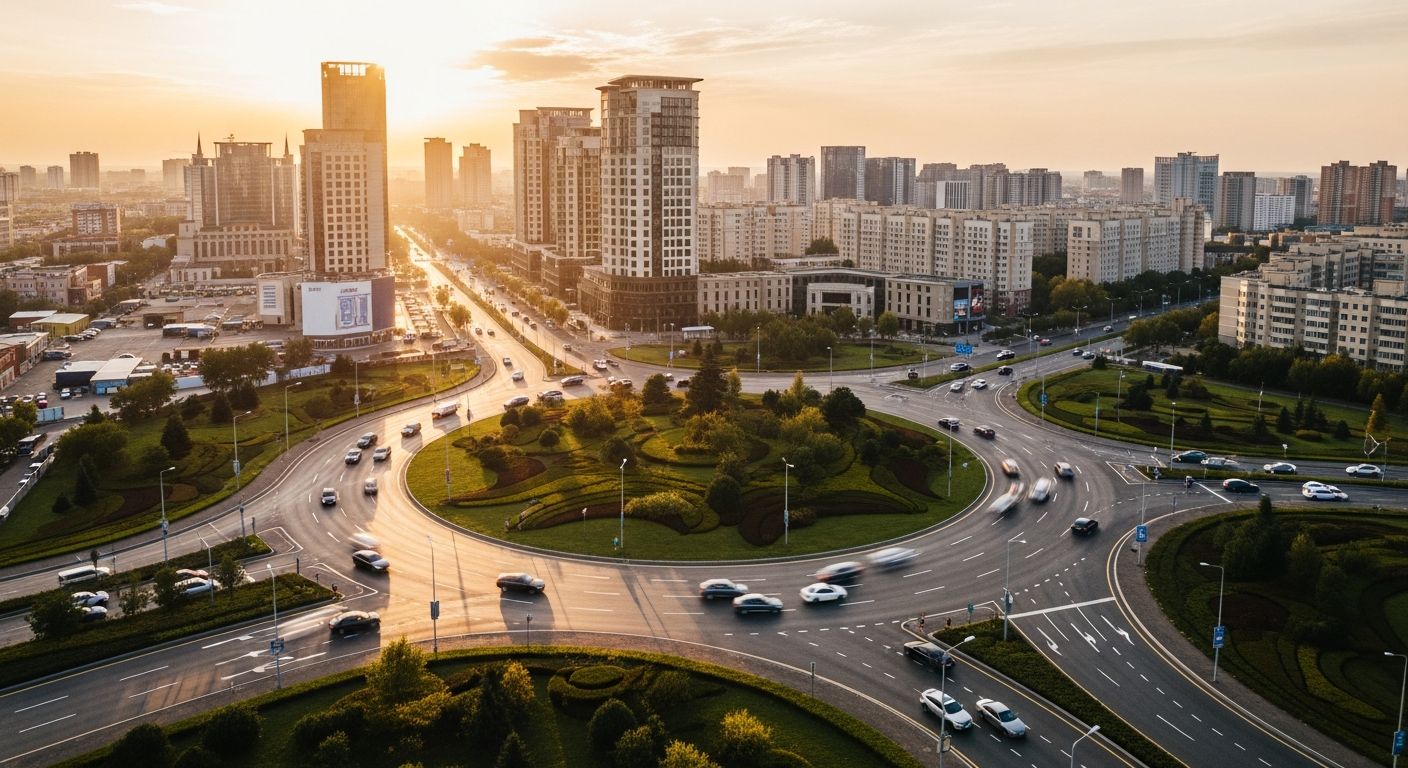
Now imagine an intersection where vehicles rarely come to a full halt, accidents are less deadly, fuel is saved, pollution drops, and traffic keeps flowing smoothly. That isn’t a futuristic dream. It already exists—and it’s called a roundabout.
Despite being common in Europe and steadily spreading across Asia and North America, roundabouts are still misunderstood. Many drivers see them as confusing or chaotic. In reality, they are one of the most intelligently designed traffic systems ever created.
This article breaks down why roundabouts are more efficient than traffic lights—in terms of traffic flow, safety, cost, environment, and even human psychology. Learn Why Roundabouts Are More Efficient Than Traffic Lights.
1. The Core Idea: Flow vs. Stop-and-Go
At the heart of the debate is one simple principle:
Traffic lights control traffic by stopping it.
Roundabouts control traffic by guiding it.
Traffic lights work on rigid cycles. Green, yellow, red—whether cars are coming or not. This creates:
- Unnecessary waiting
- Long queues
- Sudden acceleration and braking
- Driver frustration
Roundabouts, on the other hand, are designed around continuous movement. Vehicles slow down, yield if necessary, and merge into a circulating flow.
Instead of fighting traffic, roundabouts cooperate with it.
2. Why Roundabouts Move More Cars in Less Time
2.1 No Wasted Green Lights
At signalized intersections:
- One direction gets green
- All others wait—even if there’s no traffic
At roundabouts:
- Every approach can move whenever there’s a safe gap
- No time is wasted on empty lanes
This single change dramatically increases efficiency, especially during off-peak hours.
2.2 Continuous Yielding Beats Full Stops
Stopping a car is expensive in terms of time and energy.
- Stopping → waiting → accelerating
- Acceleration causes delays that ripple backward, creating traffic waves
Roundabouts reduce:
- Full stops
- Queue buildup
- Shockwave traffic jams
Vehicles slow down instead of stopping, which keeps traffic flowing smoothly even during heavy usage.
3. Safety: Fewer Accidents, Less Severe Crashes


Efficiency isn’t just about speed—it’s also about avoiding disruptions, and accidents are the biggest disruptions of all.
3.1 Fewer Conflict Points
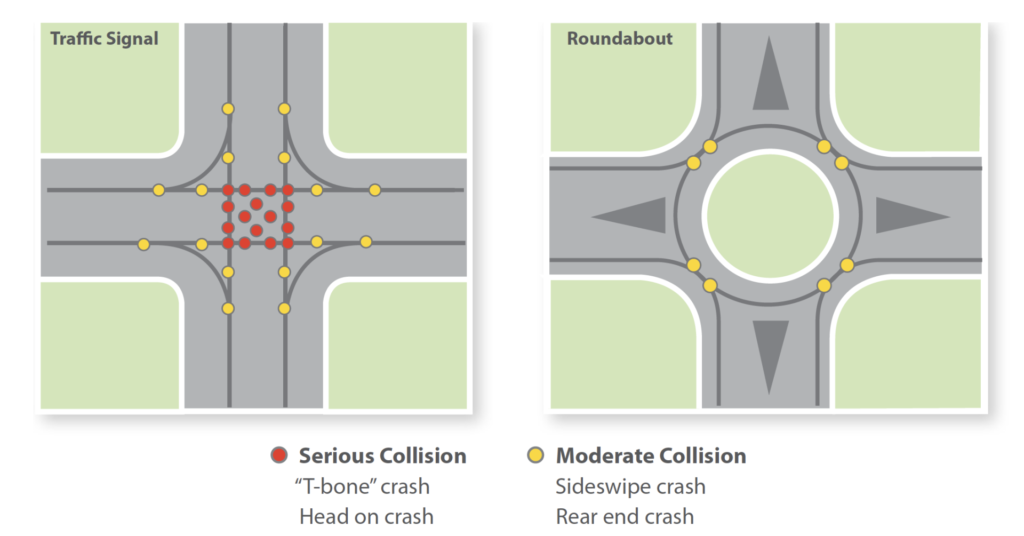
A traditional four-way intersection has:
- 32 conflict points
(places where vehicles can cross, merge, or diverge)
A roundabout has:
- 8 conflict points
That’s not a small improvement—that’s a 75% reduction.
Fewer conflict points mean:
- Fewer opportunities for crashes
- Simpler decisions for drivers
3.2 No T-Bone or Head-On Collisions
The most deadly accidents happen when vehicles hit:
- From the side (T-bone)
- Head-on at high speed
Roundabouts eliminate both:
- All traffic moves in the same direction
- Speeds are lower by design
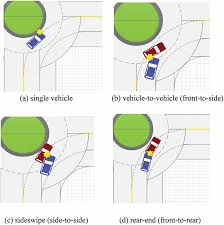
Even when accidents happen, they are usually minor sideswipes, not life-threatening crashes.
4. Human Psychology: Why Roundabouts Feel Hard but Are Easier
Many drivers think roundabouts are confusing. That fear comes from unfamiliarity—not from actual complexity.
4.1 Traffic Lights Encourage Passive Driving
At traffic lights, drivers:
- Obey signals without thinking
- Accelerate aggressively when green
- Take risks to “beat the red”
This creates:
- Red-light running
- Rear-end collisions
- Stress and impatience
4.2 Roundabouts Encourage Active Awareness
In roundabouts, drivers:
- Slow down naturally
- Make eye contact
- Read vehicle movement, not signals
This increases:
- Alertness
- Predictable behavior
- Cooperation instead of competition
Ironically, thinking more leads to safer, calmer driving.
5. Environmental Benefits: Small Design, Big Impact


4
Traffic efficiency isn’t just about drivers—it’s about the planet.
5.1 Less Idling = Less Pollution
Traffic lights force vehicles to idle:
- Engines run
- Fuel burns
- Emissions rise
Roundabouts reduce idling dramatically. Vehicles:
- Keep moving
- Burn less fuel
- Emit fewer greenhouse gases
5.2 Smoother Driving Saves Fuel
Frequent stopping and accelerating can increase fuel consumption by 20–40%.
Roundabouts promote:
- Steady speeds
- Gentle acceleration
- Lower fuel usage per trip
Multiply that across thousands of vehicles per day, and the environmental impact becomes massive.
6. Cost Efficiency: Cheaper to Build, Cheaper to Maintain
6.1 No Signals, No Electricity
Traffic lights require:
- Power supply
- Backup systems
- Sensors
- Software
- Regular maintenance
Roundabouts need:
- Road markings
- Signs
- Landscaping (optional but nice)
Once built, they operate 24/7 without electricity.
6.2 Long-Term Savings
While roundabouts may require more land initially, over time they save money through:
- Fewer accidents
- Less maintenance
- No signal replacement
- Lower policing and emergency response costs
In the long run, roundabouts are financially smarter infrastructure.
7. Emergency Vehicles and Pedestrians Benefit Too
7.1 Emergency Vehicles Move Faster
At traffic lights:
- Emergency vehicles rely on drivers reacting correctly
- Delays are common
At roundabouts:
- Traffic naturally slows and separates
- Emergency vehicles can pass through without waiting for signal changes
7.2 Safer Pedestrian Crossings
Roundabouts reduce pedestrian risk by:
- Lower vehicle speeds
- Shorter crossing distances
- One-direction traffic at a time
Pedestrians cross after exiting traffic, not in the middle of high-speed flows.
8. When Traffic Lights Still Make Sense
To be fair, roundabouts are not perfect for every situation.
Traffic lights may still be better when:
- Pedestrian volumes are extremely high
- Space is very limited
- Traffic patterns are highly uneven
- Public transport priority is required
However, in most medium-volume intersections, roundabouts outperform signals in almost every measurable way.
9. Why Some Countries Love Roundabouts (And Others Don’t)
Countries with widespread roundabout use tend to:
- Teach them early in driver education
- Design them clearly and consistently
- Normalize yielding behavior
Resistance often comes from:
- Poor initial design
- Lack of driver education
- Fear of change
Once drivers adapt, public approval usually skyrockets.
10. The Bigger Picture: Smarter Cities Think in Flows
Modern urban planning is moving away from rigid control systems and toward adaptive design.
Roundabouts fit perfectly into:
- Smart city planning
- Sustainable transport goals
- Human-centered infrastructure
They are not just traffic solutions—they are philosophies of movement.
Conclusion: Roundabouts Are Quietly Winning the Traffic War
Roundabouts don’t shout. They don’t flash red or green. They don’t demand attention.
They simply work.
By:
- Reducing stops
- Minimizing accidents
- Saving fuel
- Lowering costs
- Encouraging cooperation
…roundabouts prove that intelligent design beats brute control.
The next time you glide through a well-designed roundabout without stopping, remember: that smooth moment is the result of decades of engineering, psychology, and urban wisdom coming together.
Traffic doesn’t need to be controlled—it needs to be understood.
And roundabouts understand traffic better than traffic lights ever will.